
Losing a permanent tooth can affect more than just your appearance. You may notice changes in how you chew, feel uncomfortable smiling in photographs, or begin avoiding certain foods. Even when the missing tooth is toward the back of your mouth, the empty space can affect your overall dental health.
For adults in Post Falls, Coeur d'Alene, Hayden, Rathdrum, Liberty Lake, and surrounding Kootenai County communities, two common replacement options are dental implants and dental bridges. Both treatments can restore the appearance and function of your smile, but they work differently. Understanding those differences can help you feel more prepared when discussing your options with your dentist.
At Post Falls Family and Cosmetic Dental, restorative dentistry focuses on helping patients regain comfort, function, and confidence through personalized treatment plans. Whether you recently lost a tooth or have been living with an empty space for years, a consultation can help determine which option is right for you.
Why Should You Replace a Missing Tooth?
It may be tempting to leave the space alone, particularly if the missing tooth is not visible when you smile. However, losing a permanent tooth can create challenges that extend beyond appearance.
Changes in Chewing and Eating
Every tooth contributes to how your bite functions. When one is missing, you may begin chewing differently or relying more heavily on the opposite side of your mouth. Some patients find that harder or tougher foods become more difficult to eat comfortably.
Over time, these adjustments may affect your comfort and make everyday meals less enjoyable.
Shifting of Surrounding Teeth
Neighboring teeth may gradually begin moving toward an empty space. This movement can change how your upper and lower teeth come together and potentially create areas that are more difficult to clean.
Replacing a missing tooth may help maintain proper spacing and reduce the risk of unwanted shifting.
Changes in Jawbone Support
The roots of natural teeth help maintain the surrounding jawbone through normal function. After a tooth is lost, the bone in that area can gradually shrink because it is no longer receiving the same stimulation.
This is one reason dental implants are often discussed when patients want a long-term tooth replacement option.
What Is a Dental Implant?
A dental implant replaces a missing tooth using an artificial root that is surgically placed into the jawbone. Once the implant has integrated with the surrounding bone and the area has healed, a custom restoration is attached to complete the replacement.
For a single missing tooth, this typically involves an implant post, a connecting component called an abutment, and a dental crown.
Benefits of Dental Implants
One major advantage of a dental implant is that it generally does not require reshaping the healthy teeth on either side of the missing space. The implant has its own support within the jawbone, allowing the surrounding natural teeth to remain independent.
Dental implants can also help preserve bone in the area where the tooth was lost. For patients who want a fixed restoration without relying on neighboring teeth, an implant may be an attractive option.
Because implants are designed to function similarly to natural teeth, patients may also appreciate the stability they provide while eating and speaking.
What Should Patients Consider Before Getting an Implant?
Implant treatment requires a surgical procedure and a healing period. The dentist must evaluate your oral health, gum condition, bone support, medical history, and other factors before determining whether treatment is appropriate.
Some patients may require bone grafting or additional preparation before an implant can be placed. Others may already have enough healthy bone to move forward with treatment.
At Post Falls Family and Cosmetic Dental, implant planning may include advanced imaging, a personalized treatment plan, and coordination with a local oral surgeon when appropriate.
If you are considering replacing a missing tooth, learn more about our dental implant services in Post Falls.
What Is a Dental Bridge?
A dental bridge is another fixed restoration used to replace missing teeth. Unlike a single-tooth implant, a traditional bridge relies on neighboring natural teeth for support.
The replacement tooth occupies the empty space, while connected crowns are attached to the supporting teeth on either side.
Benefits of Dental Bridges
One advantage of a traditional bridge is that it does not require implant surgery. For patients who are not good candidates for implant placement or prefer a nonsurgical option, a bridge may offer a practical alternative.
Bridges can also be useful when the neighboring teeth already need crowns or significant restorative treatment. In these situations, restoring the supporting teeth and replacing the missing tooth together may make sense.
Another consideration is the treatment timeline. A traditional bridge may be completed more quickly than an implant because it does not require the same bone-healing period.
What Should Patients Consider Before Getting a Bridge?
Traditional bridges usually require reshaping the adjacent supporting teeth. If those teeth are otherwise healthy, this is an important consideration because some natural tooth structure must be removed.
A bridge also requires careful daily cleaning around and beneath the replacement area. The supporting teeth must remain healthy because their condition directly affects the long-term success of the bridge.
For some patients, a bridge provides the right balance of convenience, appearance, and function. For others, preserving neighboring healthy teeth may make an implant worth considering.
Post Falls Family and Cosmetic Dental offers dental bridges and denture services for patients looking to restore missing teeth and improve everyday comfort.
Dental Implant vs. Bridge: What Are the Biggest Differences?
Both treatments can provide a natural-looking replacement, but several differences may influence your decision.
1. How the Restoration Is Supported
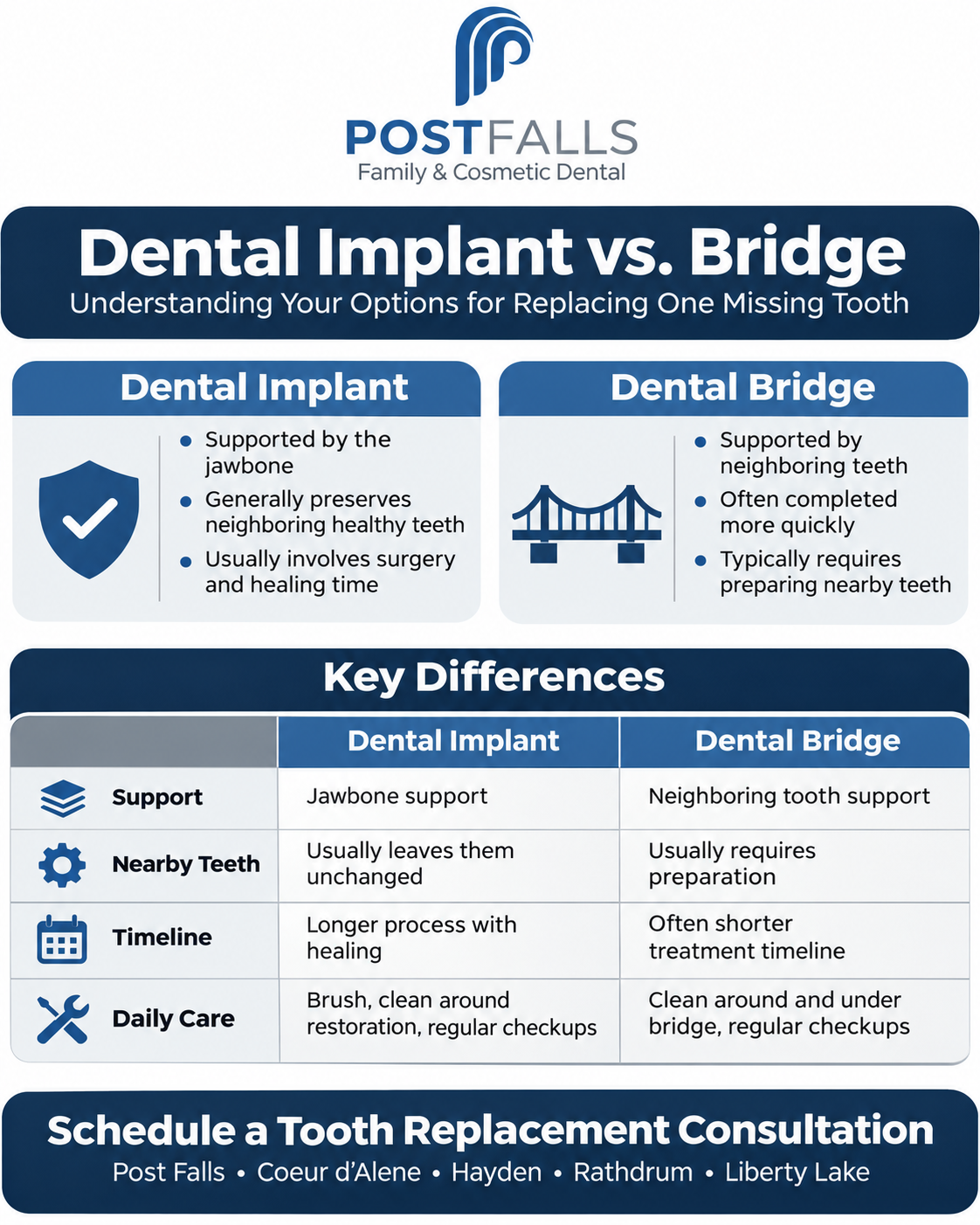
A dental implant is supported by the jawbone. A traditional bridge is supported by neighboring teeth.
This distinction affects treatment planning, maintenance, and the condition of the surrounding structures.
2. What Happens to Neighboring Teeth
A single-tooth implant generally allows adjacent healthy teeth to remain unchanged. A conventional bridge typically requires preparation of the supporting teeth.
For patients with healthy neighboring teeth, preserving that natural structure may be a significant consideration.
3. Treatment Timeline
A traditional bridge may often be completed without the extended healing period associated with implant integration.
Dental implant treatment typically involves multiple stages. After placement, the implant needs time to integrate with the surrounding bone before the final restoration is attached.
The overall timeline depends on the individual patient, bone health, and whether additional procedures are required.
4. Long-Term Maintenance
Neither option is maintenance-free.
Dental implants require daily brushing, cleaning around the restoration, and regular professional monitoring. Bridges require careful cleaning around the supporting teeth and beneath the replacement portion.
Good daily oral hygiene remains important regardless of which restoration you choose.
Which Option Is More Affordable: A Dental Implant or Bridge?
Cost is understandably one of the biggest considerations when replacing a missing tooth. Many patients want to know whether a dental bridge will be less expensive or whether investing in an implant makes more sense long term.
A dental bridge may have a lower initial cost than an implant in some cases. However, the final investment depends on the treatment plan.
Implant costs can vary based on the need for additional imaging, bone grafting, surgical placement, and the final restoration. Bridge costs can vary based on the number of supporting teeth, materials, and additional dental work required.
Consider Long-Term Value
The lowest initial cost is not always the lowest lifetime cost.
Both implants and bridges may eventually require maintenance, repair, or replacement. Their longevity depends on oral health, daily care, bite forces, medical factors, and the condition of the surrounding tissues.
Rather than choosing based on price alone, it is helpful to compare the expected treatment process, maintenance requirements, insurance benefits, and long-term considerations.
Financing May Make Treatment More Approachable
Post Falls Family and Cosmetic Dental offers financing options to help patients explore payment arrangements for recommended treatment.
For adults throughout Post Falls, Coeur d'Alene, Hayden, and Rathdrum, a consultation can provide a clearer understanding of potential costs and which replacement options may fit their budget.
You do not need to assume a dental implant is unaffordable before learning what your specific treatment would involve.
What If You Are Missing More Than One Tooth?
The number of missing teeth can change the treatment recommendations. A single implant may be appropriate for one missing tooth, but patients missing several teeth may benefit from a different restorative approach.
Implant-Supported Bridges
When multiple neighboring teeth are missing, implants can sometimes support a bridge without requiring an individual implant for every missing tooth.
This approach combines implant support with a restoration that replaces multiple teeth.
Partial Dentures
For some patients, a removable partial denture may be another reasonable option. The best choice depends on the number and location of missing teeth, remaining natural teeth, bone health, treatment goals, and budget.
Patients missing most or all of their teeth may also want to explore implant-supported dentures, which can provide additional stability compared with conventional removable dentures.
How Does Post Falls Family and Cosmetic Dental Help You Decide?
The process begins with an evaluation. During a restorative consultation, the dental team considers the condition of your remaining teeth, gum health, available bone, bite, and medical history.
Imaging may help determine whether an implant is possible and what additional preparation might be needed. Your dentist can also evaluate whether the neighboring teeth are healthy enough to support a bridge.
Your Goals Matter
Some patients prioritize preserving their surrounding natural teeth. Others want to minimize the number of surgical procedures. Some are primarily concerned about treatment time, while others are focused on long-term maintenance or affordability.
There is no single replacement option that is automatically best for every patient.
A personalized consultation helps determine which treatment offers the most appropriate balance of function, comfort, health, and cost.
What to Expect During Your Consultation
Your dental team will review your oral health, discuss the missing tooth, and explain which replacement options may be appropriate.
This is also an opportunity to discuss the treatment timeline, healing expectations, insurance coverage, and financing options.
The goal is to provide enough information for you to make a confident decision without feeling pressured into a particular treatment.
Restorative Dentistry for Post Falls and Surrounding Communities
Post Falls Family and Cosmetic Dental provides restorative dentistry for patients throughout Post Falls, Coeur d'Alene, Hayden, Rathdrum, Liberty Lake, and nearby North Idaho communities.
For patients considering dental implants, bridges, or other replacement options, having local care can be helpful because treatment may involve planning, multiple appointments, adjustments, and ongoing monitoring.
The practice provides implant consultations, dental crowns, bridges, dentures, and additional restorative services designed to address a range of dental needs.
Whether you recently lost a tooth or have been considering treatment for years, the first step is understanding your options and how each treatment may support your long-term oral health.
Schedule a Tooth Replacement Consultation in Post Falls
If you have recently lost a tooth or have been living with an empty space for years, you do not need to decide on a treatment before scheduling an appointment.
A dental evaluation can help you understand whether an implant, bridge, or another restorative option makes the most sense for your situation.
At Post Falls Family and Cosmetic Dental, the goal is to help patients make informed decisions that support their oral health, everyday comfort, and confidence.
If you live in Post Falls, Coeur d'Alene, Hayden, Rathdrum, Liberty Lake, or surrounding Kootenai County communities, schedule a tooth replacement consultation to explore your restorative dental options.
Frequently Asked Questions
-
Neither option is best for everyone. Implants provide independent support and generally do not require reshaping neighboring teeth. Bridges may be appropriate when implant surgery is not preferred or when adjacent teeth already need restorative treatment. A consultation can help determine which option fits your situation.
-
Implant treatment often requires several months because the implant needs time to integrate with the jawbone. The timeline depends on healing, bone health, and whether additional procedures are needed.
-
A bridge may still be possible, but a traditional bridge requires preparing the neighboring supporting teeth. Your dentist can explain whether an implant or another alternative may preserve more healthy tooth structure.
-
Coverage varies by policy. Some plans contribute toward certain restorative treatments, while others have exclusions or limitations. The dental office can help review your benefits and estimated costs.
-
In some cases, neighboring teeth may shift toward the empty space, chewing patterns may change, and bone loss can occur in the area. Your dentist can explain the risks associated with your specific missing tooth and whether replacement is recommended.
-
Yes, many patients can still explore tooth replacement after years of missing a tooth. However, bone loss, shifting teeth, and changes to the bite may affect the available options. An evaluation helps determine which treatments may be appropriate.
-
Yes. Post Falls Family and Cosmetic Dental is located in Post Falls and serves patients from Coeur d'Alene, Hayden, Rathdrum, Liberty Lake, and surrounding Kootenai County communities.
