

Headaches and neck pain are easy to blame on stress, posture, poor sleep, or a busy schedule. For many adults in Post Falls, Coeur d’Alene, Hayden, Rathdrum, and the surrounding Kootenai County area, those may be part of the problem. However, recurring headaches, neck tension, jaw soreness, and shoulder tightness can also be connected to TMJ disorder.
TMJ refers to the temporomandibular joint, which connects your jaw to your skull. This joint helps you chew, speak, yawn, smile, and move your mouth comfortably. When the joint, surrounding muscles, bite, airway, tongue function, or supporting tissues are not working well together, symptoms can spread beyond the jaw.
That is why TMJ symptoms can be confusing. Some patients do not start by searching for jaw pain treatment. They start by wondering why they keep waking up with headaches, why their neck feels tight, why their shoulders always feel tense, or why their jaw clicks when they chew.
At Post Falls Family and Cosmetic Dental, patients can receive a more complete evaluation to better understand whether headaches, neck tension, jaw pain, clenching, grinding, snoring, sleep apnea concerns, or oral muscle function may be connected.
How TMJ Can Contribute to Headaches
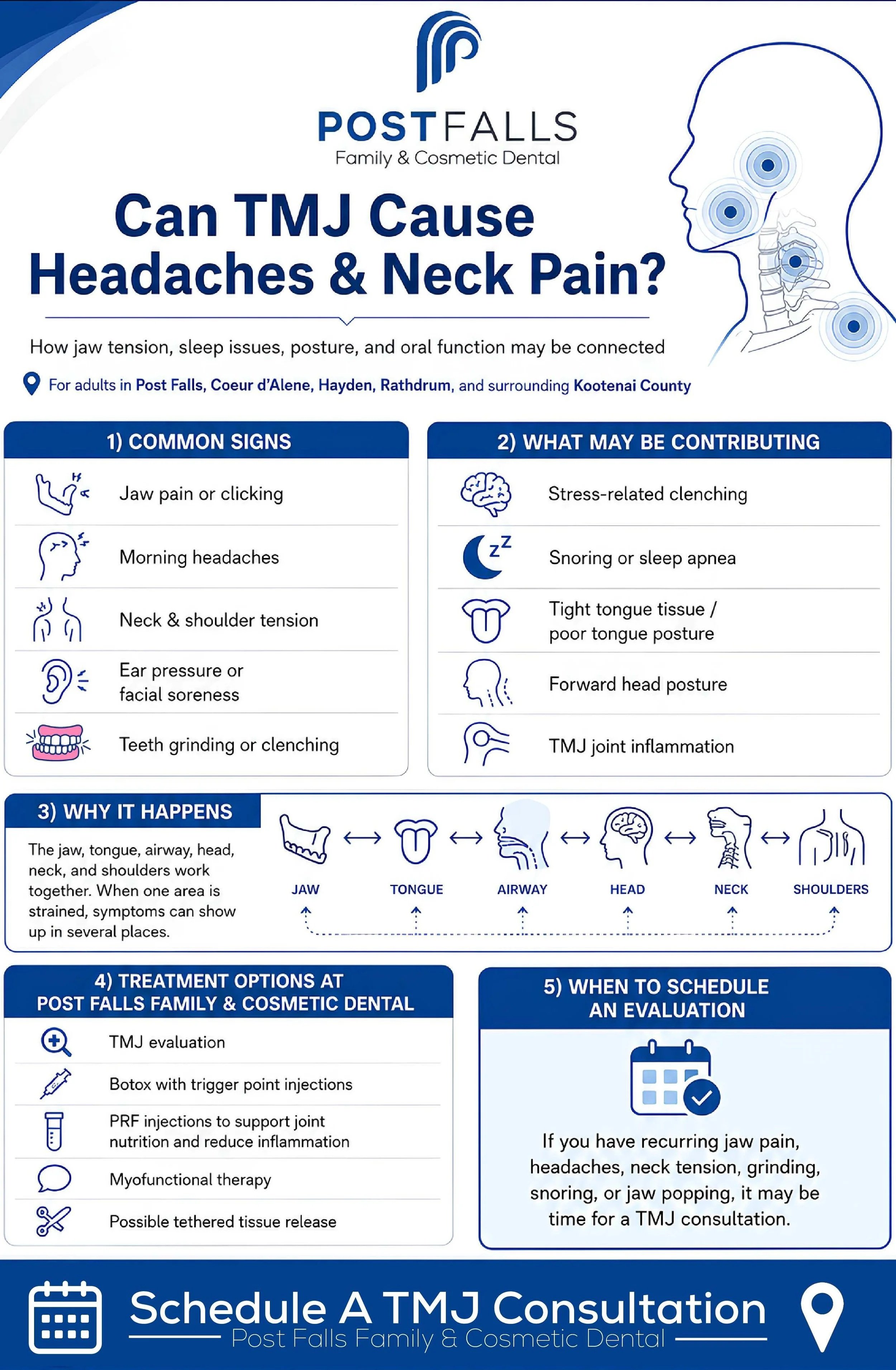
TMJ-related headaches often happen because the muscles around the jaw are being overworked. When you clench, grind, or hold tension in your jaw, the muscles in your face, temples, head, neck, and shoulders can become strained. Over time, that tension may lead to headaches that feel like pressure around the temples, forehead, sides of the head, or behind the eyes.
Some patients notice that their headaches are worse in the morning. Others notice them after chewing, talking for long periods, or going through a stressful day. If headaches are paired with jaw soreness, clicking, popping, tooth sensitivity, facial tightness, or neck tension, TMJ may be worth evaluating.
Not every headache is caused by TMJ disorder. Headaches can have many causes, and ongoing or severe headaches should always be taken seriously. However, when headaches happen alongside jaw symptoms, a TMJ consultation can help determine whether your jaw joint, bite, muscles, airway, or oral posture may be contributing to the problem
Why Neck and Shoulder Tension May Be Connected
The jaw does not work in isolation. It is part of a larger system that includes the head, neck, shoulders, airway, tongue, and facial muscles. When the jaw is irritated or the surrounding muscles are overactive, tension can spread into nearby areas.
This is why some TMJ patients feel tightness in their neck and shoulders even when the main issue begins in the jaw. The body often compensates for discomfort by shifting posture, tightening muscles, or changing the way it holds the head and neck. Over time, those compensations can become part of a daily pattern.
For adults in North Idaho who spend long hours at a desk, drive frequently, work physically demanding jobs, or carry stress in the jaw and shoulders, it can be difficult to know where the pain is starting. A TMJ evaluation helps look at more than one symptom at a time. Instead of treating jaw pain, headaches, and neck tension as separate problems, the goal is to better understand how they may be connected.
Clenching and Grinding May Be More Than Stress
Many people assume they clench or grind their teeth because they are stressed. Stress can absolutely play a role. During the day, some patients clench while working, driving, concentrating, exercising, or dealing with pressure. At night, however, grinding and clenching may also be related to sleep and airway concerns.
When a person snores or struggles with sleep-disordered breathing, including possible sleep apnea, the body may respond by shifting the jaw or activating jaw muscles during sleep. For some patients, nighttime clenching or grinding may be connected to the body’s effort to maintain a better airway.
This matters because the solution may not be as simple as telling someone to “relax their jaw.” If you wake up with jaw pain, morning headaches, dry mouth, tooth sensitivity, or tired facial muscles, it may be worth discussing sleep, snoring, and airway symptoms during your TMJ consultation.
Signs that sleep or airway may be part of the conversation include snoring, waking up tired,
morning headaches, dry mouth, mouth breathing, restless sleep, teeth grinding, jaw soreness, and being told you may have sleep apnea. A more complete evaluation can help determine whether TMJ symptoms, airway concerns, and oral muscle function are overlapping.
How Tongue Function Can Affect Headaches, Posture, and TMJ Symptoms
One area many patients do not think about is tongue function. The tongue plays an important role in breathing, swallowing, speaking, resting posture, and jaw stability. When the tongue does not rest or move properly, nearby muscles may compensate.
In some patients, tight tethered tongue tissue and surrounding fascia may contribute to headaches, forward head posture, neck tightness, shoulder tension, jaw strain, and TMJ symptoms. A restricted tongue may make it harder for the tongue to rest in the proper position, which can affect how the mouth, jaw, airway, and neck work together.
This does not mean every headache or TMJ issue is caused by tongue restriction. However, for patients who have recurring jaw pain, neck tension, shoulder tightness, mouth breathing, snoring, poor tongue posture, or symptoms that have not improved with basic approaches, tongue function may be worth evaluating.
Post Falls Family and Cosmetic Dental offers access to an in-depth evaluation with a myofunctional therapist, one of the only myofunctional therapists in Kootenai County. This is valuable for patients who need a deeper look at oral function, tongue posture, breathing patterns, muscle habits, and whether restricted tissue may be contributing to their symptoms.
What Is Myofunctional Therapy?
Myofunctional therapy focuses on the muscles of the tongue, lips, jaw, cheeks, face, and airway. The goal is to improve how these muscles function during breathing, swallowing, speaking, and resting posture.
For TMJ patients, myofunctional therapy may be recommended when tongue posture, mouth breathing, swallowing patterns, oral habits, or muscle dysfunction appear to be contributing to jaw strain. Therapy can help retrain oral and facial muscles so they work more efficiently together.
In some cases, the evaluation may also show that a patient has tethered oral tissue that limits tongue mobility. When appropriate, myofunctional therapy may be combined with a possible release. Therapy is often important before and after a release because the muscles need to learn a better pattern of movement and rest.
For patients in Post Falls, CDA, Hayden, Rathdrum, and surrounding Kootenai County communities, having this level of evaluation available locally can be a major benefit. It allows patients to look beyond surface-level symptoms and better understand the role that tongue function, airway, posture, and muscle patterns may be playing.
What About Jaw Clicking and Popping?

Jaw clicking and popping can be another sign that the TMJ is not moving smoothly. Some people experience clicking without pain, while others feel discomfort, pressure, locking, or limited movement. The sound itself does not always mean there is a serious issue, but clicking or popping paired with pain, stiffness, headaches, or jaw fatigue should be evaluated.
In some cases, popping and clicking may be related to inflammation, joint irritation, disc movement, muscle imbalance, or strain inside the TMJ. Treatment depends on what is causing the issue.
PRF injections may be part of the conversation for some patients with TMJ inflammation, joint irritation, popping, or clicking. PRF stands for platelet-rich fibrin. It uses a concentrated portion of the patient’s own blood to help support the joint environment. PRF may provide nutrition to the joint area and support inflammation reduction, which can be helpful when joint irritation is part of the problem.
PRF is not the right fit for every TMJ patient. The best first step is an evaluation to determine whether joint inflammation, muscle tension, airway concerns, clenching, oral posture, or another factor is contributing to the symptoms.
TMJ Treatment Should Start With the Right Evaluation
Because TMJ symptoms can come from multiple contributing factors, treatment should not be based on guesswork. A patient with muscle tension may need a different approach than a patient with airway-related clenching, joint inflammation, tongue restriction, or bite-related strain.
At Post Falls Family and Cosmetic Dental, TMJ treatment may include a combination of evaluation, education, bite assessment, oral appliance considerations, Botox with trigger point injections, PRF injections, myofunctional therapy, airway evaluation, and possible tethered tissue release when appropriate.
Botox with trigger point injections may help relax overactive jaw and facial muscles that contribute to pain, tension, and headaches. PRF injections may be discussed when joint inflammation, popping, or clicking is part of the concern. Myofunctional therapy may be recommended when tongue function, breathing patterns, posture, or oral muscle habits appear to be contributing to the problem.
The goal is to identify what is actually driving the symptoms and create a plan that supports comfort, function, airway health, posture, and long-term oral wellness.
Why Local TMJ Care Matters in Post Falls and Kootenai County
When you are dealing with jaw pain, headaches, or neck tension, it helps to have care close to home. Adults in Post Falls, Coeur d’Alene, Hayden, Rathdrum, Liberty Lake, and nearby North Idaho communities should not have to ignore symptoms because they are unsure where to start.
A local TMJ consultation gives you the opportunity to explain your symptoms, receive an evaluation, and understand whether your headaches, neck pain, jaw clicking, clenching, grinding, snoring, or sleep concerns may be connected. It also gives your dental team the chance to look at your oral health as a whole.
Post Falls Family and Cosmetic Dental serves patients throughout the Kootenai County area with dental care that considers comfort, function, airway, and long-term health. For patients who also care about the appearance of their smile, TMJ treatment may also connect to restorative dentistry, cosmetic dentistry, and maintaining a healthy bite.
When Should You Schedule a TMJ Consultation?
You should consider scheduling a TMJ consultation if you have recurring headaches, jaw pain, jaw clicking, popping, facial soreness, neck tension, shoulder tightness, tooth sensitivity, or pain while chewing. You should also ask about TMJ if you wake up with a sore jaw, grind your teeth, clench at night, or feel like your jaw is tired in the morning.
It may also be time to schedule an evaluation if you snore, suspect sleep apnea, wake up tired, breathe through your mouth at night, have forward head posture, feel constant tightness in your neck and shoulders, or have been told you may have a tongue-tie or restricted tongue movement.
A consultation does not mean you are committing to treatment right away. It gives you a better understanding of what may be causing your symptoms and what options may be available.
Do Not Keep Guessing About Headaches and Neck Pain

Headaches and neck tension can affect your work, sleep, mood, energy, and quality of life. If these symptoms keep showing up alongside jaw pain, clenching, grinding, clicking, popping, snoring, or facial tightness, TMJ may be part of the picture.
Post Falls Family and Cosmetic Dental helps adults in Post Falls, Coeur d’Alene, Hayden, Rathdrum, Liberty Lake, and surrounding Kootenai County communities explore TMJ treatment in a comfortable and educational setting. With options that may include Botox with trigger point injections, PRF injections, myofunctional therapy, airway evaluation, and possible tethered tissue release when appropriate, patients can receive a more complete look at what may be contributing to their discomfort.
Schedule a TMJ consultation today to learn whether your headaches, neck tension, jaw pain, or sleep-related clenching may be connected to TMJ disorder.
Frequently Asked Questions About TMJ & Neck Pain
-
Yes, TMJ disorder may contribute to headaches when the jaw joint or surrounding muscles are irritated or overworked. TMJ-related headaches may feel like pressure around the temples, forehead, jaw, face, or sides of the head. If headaches happen with jaw pain, clicking, clenching, grinding, or facial soreness, a TMJ evaluation may be helpful.
-
TMJ symptoms can sometimes contribute to neck and shoulder tension because the jaw, head, neck, shoulders, tongue, and facial muscles work together. When the jaw is strained, nearby muscles may compensate, which can create tightness beyond the jaw itself.
-
Snoring and sleep apnea may contribute to nighttime clenching or grinding in some patients. When the body struggles to maintain a healthy airway during sleep, the jaw and tongue may shift in ways that increase muscle activity. If you wake up with jaw pain, headaches, dry mouth, or tired facial muscles, sleep and airway concerns should be discussed.
-
In some patients, tethered tongue tissue and tight fascia may contribute to poor tongue posture, forward head posture, headaches, neck tension, shoulder tightness, and jaw strain. An in-depth evaluation with a myofunctional therapist can help determine whether tongue function may be part of the problem.
-
That is one of the benefits of the Smile Trial. It gives you a chance to preview your possible smile and talk through your options before committing. If veneers do not feel like the right fit, your dental team can discuss other cosmetic options such as whitening, bonding, alignment, crowns, or phased treatment.
-
PRF injections may be discussed for patients with TMJ inflammation, joint irritation, popping, or clicking. PRF may help provide nutrition to the joint area and support inflammation reduction. A consultation is needed to determine whether PRF is appropriate.
-
Yes. Post Falls Family and Cosmetic Dental is located in Post Falls and serves patients from Coeur d’Alene, Hayden, Rathdrum, Liberty Lake, and surrounding Kootenai County communities.
