
Do I Need a Filling or a Crown? How Post Falls Families Can Know the Difference
When a tooth is damaged, it is not always easy to know what type of treatment you need. Maybe an old filling broke. Maybe you bit down and felt part of a tooth crack. Maybe your dentist found a cavity during a routine exam and explained that the damaged area may be larger than expected.
One of the most common questions patients ask is: Do I need a filling, or do I need a crown?
For patients in Post Falls, Coeur d’Alene, Hayden, Rathdrum, Liberty Lake, and surrounding Kootenai County communities, the answer depends on the condition of the tooth. Both fillings and crowns are designed to repair teeth, but they are used for different levels of damage.
At Post Falls Family and Cosmetic Dental, the goal is to restore the tooth in a way that protects your oral health, supports comfortable chewing, and preserves as much healthy tooth structure as possible.
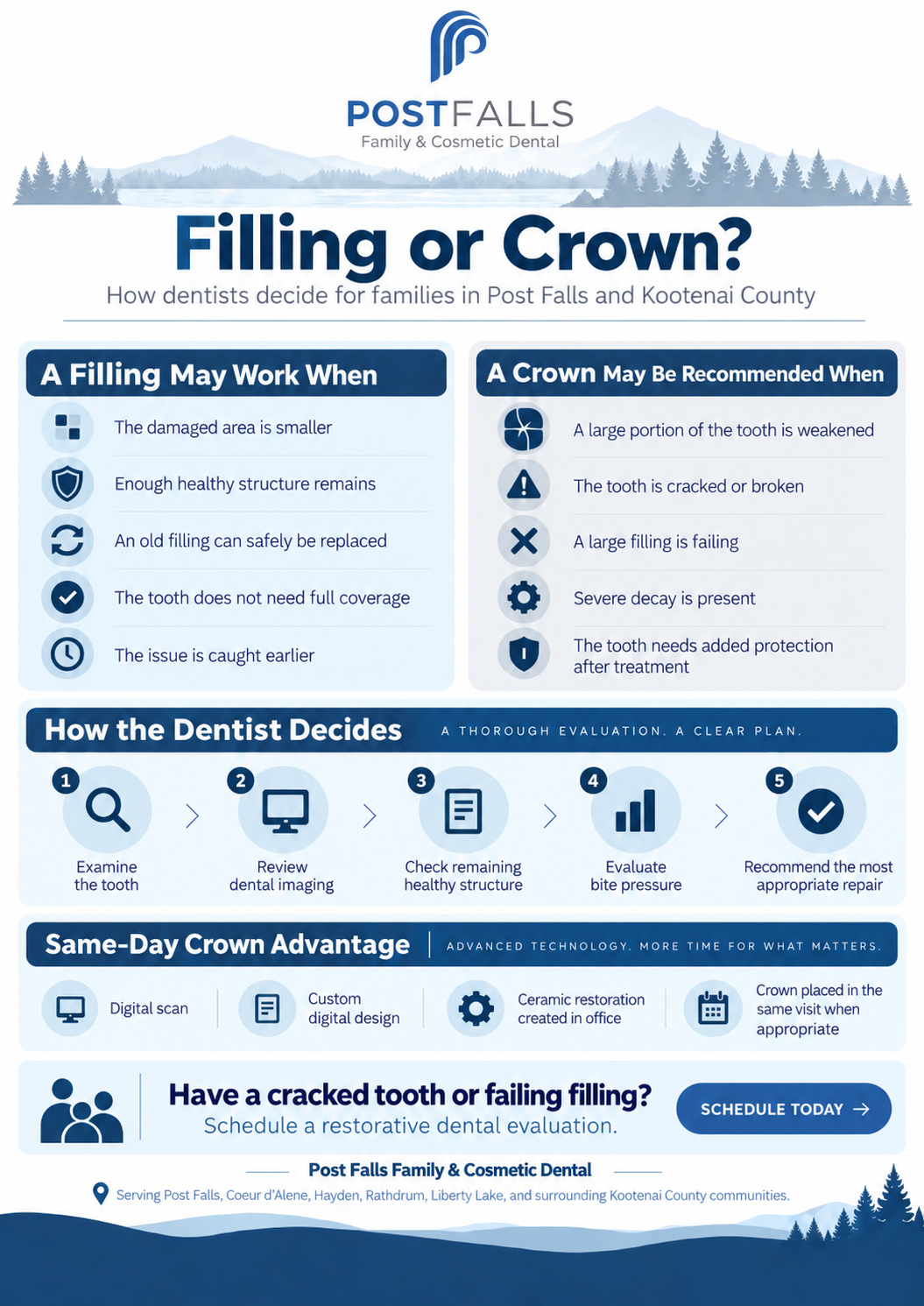
What Is the Difference Between a Filling and a Crown?
A filling and a crown can both repair a damaged tooth, but they work in different ways.
What a Filling Does
A filling is used when a smaller or moderate portion of the tooth has been damaged by decay, wear, or minor breakage. The damaged area is cleaned out, and a tooth-colored filling material is placed to rebuild that portion of the tooth.
Fillings work well when there is enough healthy tooth structure remaining to support the repair. They are often used for cavities, small areas of damage, or replacing an older filling when the surrounding tooth is still strong.
At Post Falls Family and Cosmetic Dental, tooth-colored composite fillings can help restore damaged areas while blending more naturally with the smile.
What a Crown Does
A crown is used when a tooth needs more support than a filling can provide. Instead of repairing only one section, a crown covers the visible portion of the tooth to help protect and strengthen it.
Crowns are often recommended for teeth that are cracked, broken, severely decayed, weakened by a large filling, or in need of additional support after certain root canal treatments.
A crown is not always a sign that the tooth is beyond saving. In many cases, a crown is recommended because the dentist is trying to protect the natural tooth and help it continue functioning for years to come.
When Is a Filling Usually Enough?
Not every damaged tooth needs a crown. In many cases, a filling may be the right solution.
Small Cavities
When tooth decay is found early, a filling can often repair the area before the problem becomes more serious. The damaged portion is removed, and the filling restores the tooth’s shape and function.
This is one reason regular dental exams are important. Smaller cavities are often easier to treat than larger areas of decay that have weakened more of the tooth.
Minor Chips or Wear
A filling or bonding material may also be used for smaller chips, worn edges, or minor damage, depending on where the issue is located and how much pressure that part of the tooth receives when you bite.
For example, a small chip on a front tooth may be treated differently than a damaged back tooth that handles heavy chewing pressure. The dentist will evaluate the location, size, and cause of the damage before recommending treatment.
Replacing an Older Filling
Sometimes an older filling needs to be replaced because it is worn, cracked, loose, or no longer sealing the tooth properly. If the surrounding tooth remains strong, a new filling may be appropriate.
However, if the old filling is very large or the tooth around it has weakened, a crown may provide better long-term protection.
When Might a Crown Be the Better Choice?
A crown may be recommended when the tooth needs more coverage, strength, or protection than a filling can provide.
The Tooth Has a Large Filling
Teeth with very large fillings can become weaker over time. As more of the natural tooth is replaced by filling material, the remaining walls of the tooth may become thinner and more likely to crack.
If an old filling fails and very little healthy structure remains, placing another large filling may not be the most reliable option. A crown can help surround and support the remaining tooth.
The Tooth Is Cracked
Cracked teeth can be tricky because the damage is not always obvious at first. Some cracks are small and limited to the outer layer of the tooth. Others can extend deeper and create pain when biting, temperature sensitivity, or a risk of further breakage.
A crown may be recommended when the tooth needs reinforcement to reduce the chance of the crack worsening.
The Tooth Is Broken
If a tooth has broken, the treatment depends on how much structure remains. A small break may be repairable with filling or bonding material. A larger break may require a crown to rebuild and protect the tooth.
The dentist will also evaluate whether the break has affected the nerve inside the tooth. If it has, root canal therapy may need to be discussed before the final restoration.
The Tooth Has Severe Decay
A larger cavity can remove too much natural structure for a filling to be dependable. When decay is extensive, a crown may be needed to restore the tooth’s shape, strength, and function.
The goal is to avoid placing a restoration that is too weak for the amount of damage present.
The Tooth Has Had Root Canal Treatment
Some teeth need a crown after root canal therapy, especially back teeth that handle heavy chewing forces or teeth that have already lost significant structure. After the infection or damaged inner tissue is treated, the tooth may need a strong final restoration to protect it.
A consultation can help determine whether a filling or crown is the right final step after root canal treatment.
Why the Dentist Looks at More Than the Cavity
Patients sometimes assume the decision is based only on the size of the cavity. While size matters, it is not the only factor.
Remaining Tooth Structure Matters
The dentist needs to determine how much healthy tooth is left. A tooth with strong surrounding walls may support a filling well. A tooth with thin, weakened, or cracked walls may need the protection of a crown.
Bite Pressure Matters
Back teeth take on significant force when you chew. If a damaged tooth is located in an area that handles a lot of pressure, the dentist may recommend a stronger restoration.
A repair that looks fine on the surface still needs to hold up during daily eating and chewing.
Existing Dental Work Matters
Old fillings, crowns, and previous dental treatment can affect the recommendation. A tooth that has already been restored several times may need more support than a tooth being treated for the first time.
Symptoms Matter
Pain when biting, lingering sensitivity, sharp edges, swelling, or a filling that suddenly feels different can all help the dentist understand what may be happening.
However, not every damaged tooth hurts. A tooth can have decay, cracks, or a failing filling before symptoms become obvious.
Can You Get a Dental Crown in One Visit?
One benefit available at Post Falls Family and Cosmetic Dental is same-day CEREC crown technology.
What Is a Same-Day Crown?
A same-day crown allows the dental team to digitally scan, design, create, and place certain ceramic crowns in a single visit when appropriate. This can remove the need for a temporary crown and a second appointment.
For busy patients and families in Post Falls, Coeur d’Alene, Hayden, Rathdrum, Liberty Lake, and nearby North Idaho communities, this can make restorative dentistry more convenient.
Why Patients Appreciate Same-Day Crowns
Traditional crowns often require multiple visits. The first appointment prepares the tooth and places a temporary crown. The second appointment places the final crown after it has been made by an outside lab.
With same-day crown technology, many appropriate cases can be completed more efficiently. This can reduce time away from work, school, family schedules, and other responsibilities.
What If My Tooth Does Not Hurt?
A lack of pain does not always mean the tooth is healthy.
Some cavities, cracks, and failing fillings do not hurt right away. In some cases, pain only begins once the problem has become more advanced.
Do Not Wait for Pain to Be the Warning Sign
If part of your tooth breaks, a filling falls out, or something feels different when you bite, it is worth scheduling an evaluation. Waiting can allow the damage to grow and may limit your treatment options.
A smaller repair may become a larger one if the tooth continues to weaken.
Routine Exams Help Catch Problems Earlier
Regular dental exams give the dental team a chance to monitor older fillings, identify cracks, check for decay, and recommend treatment before the tooth becomes painful or breaks further.
For many families, preventive visits are what make restorative dentistry simpler and more manageable.
Filling or Crown: How the Decision Is Made
A restorative dental evaluation helps determine which option is best for your tooth.
Step 1: Examine the Tooth
The dentist will look at the visible damage, check the condition of any old fillings, evaluate the surrounding tooth structure, and ask about your symptoms.
Step 2: Review Dental Imaging
X-rays or other imaging may be used to see areas that are not visible during the exam. This helps the dentist understand the depth of decay, the condition of the root, and whether the inner portion of the tooth may be involved.
Step 3: Evaluate Strength and Function
The dentist considers whether the tooth can safely support a filling or whether it needs the added coverage of a crown.
Step 4: Recommend the Right Restoration
The final recommendation should balance health, function, durability, appearance, and long-term protection. The goal is not simply to fix the tooth for today. The goal is to restore it in a way that supports everyday chewing and helps prevent avoidable future problems.
What About Cosmetic Appearance?
Restorative dentistry is primarily focused on health and function, but appearance still matters. A damaged tooth can affect the way your smile looks, especially if the tooth is visible when you talk or smile.
Tooth-Colored Fillings
Composite fillings can be shade-matched to blend more naturally with the surrounding tooth. This makes them a helpful option for patients who want a restoration that does not stand out.
Ceramic Crowns
Ceramic crowns can also be designed to look natural while restoring strength and structure. This is especially helpful when the damaged tooth is visible or when appearance and function both matter.
At Post Falls Family and Cosmetic Dental, restorative care can support both oral health and smile confidence.
Restorative Dentistry for Local Families in Post Falls and Kootenai County
Post Falls Family and Cosmetic Dental serves patients from Post Falls, Coeur d’Alene, Hayden, Rathdrum, Liberty Lake, and surrounding North Idaho communities. For local families, having restorative services close to home can make it easier to address dental concerns before they become more complicated.
Whether you need a tooth-colored filling, a same-day crown, root canal therapy, or another restorative service, the first step is understanding what the tooth actually needs.
You do not need to decide whether you need a filling or crown before scheduling. That is what the exam is for.
When Should You Schedule an Appointment?
You should schedule a restorative dental evaluation if you notice a cracked tooth, broken tooth, lost filling, sharp edge, pain when biting, temperature sensitivity, or an old filling that feels loose or different.
You should also ask about older fillings during routine dental exams, especially if they are large or have been in place for many years.
Getting an answer early can help protect the tooth and may prevent a more urgent dental situation later.
Protect the Tooth Before the Problem Gets Worse
Fillings and crowns both play an important role in restorative dentistry. A filling may be the right solution when the damaged area is smaller and enough healthy tooth remains. A crown may be recommended when the tooth is cracked, broken, weakened, severely decayed, or needs additional protection.
For patients in Post Falls, Coeur d’Alene, Hayden, Rathdrum, Liberty Lake, and surrounding Kootenai County communities, Post Falls Family and Cosmetic Dental can evaluate the tooth and explain which option makes the most sense.
If you are unsure whether you need a filling or a crown, schedule a restorative dental evaluation today. The sooner the tooth is checked, the more options you may have for protecting your smile.
Frequently Asked Questions
-
A crown is not automatically better than a filling. The best option depends on how much healthy tooth structure remains and how much support the tooth needs. Fillings are often used for smaller areas of damage, while crowns are used when the tooth needs more protection.
-
Sometimes a large filling can be replaced, but not always. If the surrounding tooth is still strong, a new filling may work. If the tooth has become weakened, cracked, or has very little structure left, a crown may be the better option.
-
The tooth is numbed during crown treatment so the procedure can be completed comfortably. Some patients may have temporary soreness or sensitivity afterward, but your dental team will explain what to expect and how to care for the tooth.
-
Yes, many crowns can be completed with same-day CEREC technology when the case is appropriate. This allows the dental team to digitally design, create, and place the crown during one appointment.
-
Some teeth need a crown after root canal therapy, especially back teeth or teeth with significant structural damage. The dentist will evaluate the amount of remaining tooth structure before recommending the final restoration.
-
Yes. Post Falls Family and Cosmetic Dental is located in Post Falls and serves patients from Coeur d’Alene, Hayden, Rathdrum, Liberty Lake, and surrounding Kootenai County communities.
