
Secure Your Loose Dentures With Implants: A More Affordable Option Than Many Patients Expect
Loose dentures can make everyday life harder than it needs to be. If your dentures slip when you eat, move when you talk, rub against your gums, or make you nervous in public, you are not alone. Many people with full dentures eventually reach a point where adhesive, adjustments, and “just dealing with it” are no longer enough.
For adults in Post Falls, Coeur d’Alene, Hayden, Rathdrum, Liberty Lake, and the surrounding Kootenai County area, implant-supported dentures may offer a more stable solution. The best part is that many patients are surprised to learn that securing dentures with implants does not always mean choosing the most expensive full-mouth implant option.
At Post Falls Family and Cosmetic Dental, patients can explore implant-supported denture options designed around comfort, stability, function, and budget. Depending on your needs, you may be able to use fewer implants than you expected. In some cases, we may even evaluate your existing denture to see if it can be used as part of the plan, which may help keep costs more controlled.
Why Loose Dentures Are So Frustrating
Traditional dentures can restore the appearance of a full smile, but they may not feel as stable as patients hope. A moving denture can affect eating, speaking, smiling, laughing, and social confidence.
Dentures Can Change Over Time
Even if your dentures fit well at first, your mouth can change after tooth loss. Your gums and jawbone may gradually change shape, which can make dentures feel looser over time. When that happens, patients may notice more slipping, rubbing, sore spots, and dependence on adhesive.
This can be especially frustrating with lower dentures, which often have less natural suction and support than upper dentures. For some patients, the lower denture becomes the main source of daily frustration.
Loose Dentures Can Limit What You Eat
One of the biggest reasons patients ask about implant-supported dentures is because they miss certain foods. Steak, apples, corn on the cob, salads, crunchy vegetables, nuts, and other foods may become difficult or embarrassing to eat when dentures move.
Over time, some patients begin choosing softer foods not because they want to, but because they are trying to avoid discomfort or embarrassment. Implant support may help some patients regain more confidence while eating.
How Implants Help Secure Dentures
Dental implants can act like anchors for a denture. Instead of relying only on suction, gum support, and adhesive, an implant-supported denture can attach to implants placed in the jawbone. This can help reduce movement and improve stability.
Implants Can Add Retention and Support
The goal of implants with dentures is not always to replace every missing tooth with a separate implant. For many patients, the goal is to give the denture a more secure foundation. This may help the denture feel more dependable when eating, talking, or smiling.
Depending on the case, the denture may snap onto implants or use a more advanced support system. The right approach depends on your oral health, bone support, denture condition, and goals.
This Can Be Life-Changing for the Right Patient
For someone who has struggled with loose dentures for years, added stability can make a major difference. Being able to enjoy more foods, speak without worrying, and laugh without fear of the denture shifting can improve quality of life.
For many patients, this is about more than dentistry. It is about feeling normal again.
You May Not Need as Many Implants as You Think
Many people avoid asking about implants because they assume the cost will be too high. They may have heard about full-mouth implant cases and assumed that was the only option. In reality, implant-supported dentures can sometimes be planned in different levels.
Some Plans May Use Fewer Implants
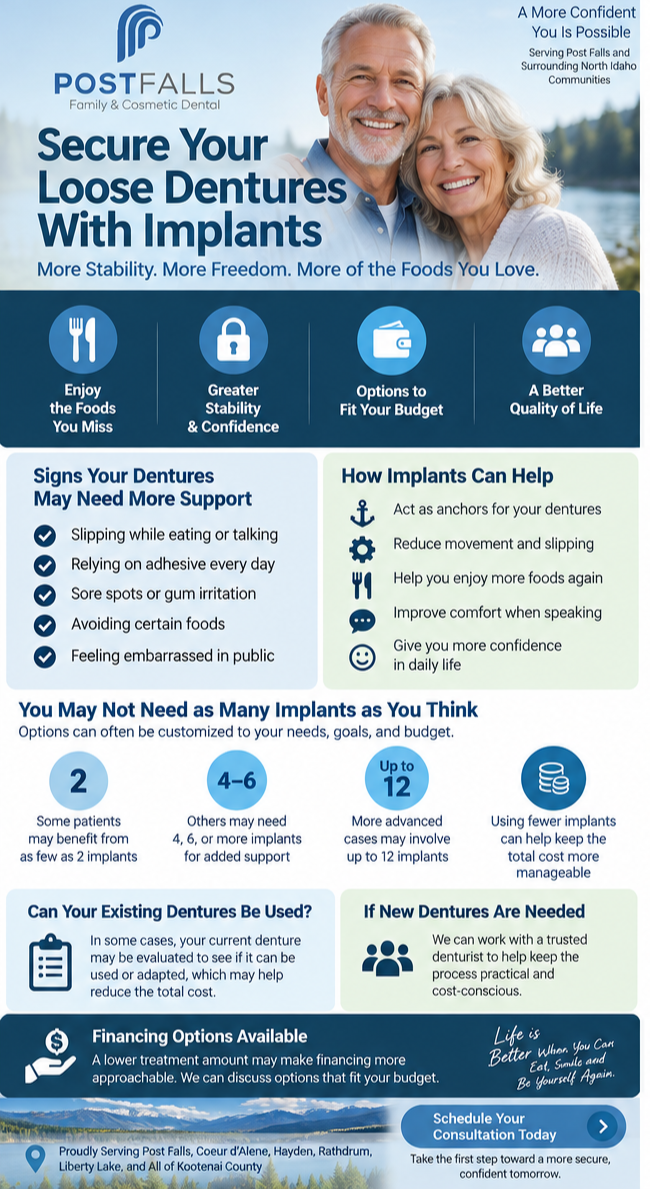
Depending on the patient, some denture stabilization plans may use as few as 2 implants. Other patients may benefit from 4, 6, or more implants. In larger or more advanced cases, a plan involving up to 12 implants may be discussed.
The number of implants depends on several factors, including your bone health, whether the upper or lower denture is being stabilized, how much support is needed, and whether the denture is removable or more fixed.
Cost Can Be Controlled by Matching the Plan to the Patient
The goal is not to push every patient into the most expensive option. The goal is to evaluate your situation and explain what level of treatment may actually help. For some patients, a smaller implant-supported denture plan may be enough to create a meaningful improvement.
This is why a consultation matters. You may have more options than you realize, especially if you have been assuming implants are automatically out of reach.
Can Your Existing Denture Be Used?
One of the biggest cost-saving possibilities is whether you can use or adapt your current denture. This is not possible in every case, but it is worth evaluating.
Existing Dentures May Help Reduce Cost
If your denture is in good condition, has the right fit, and can be safely modified, it may be possible to use it as part of an implant-supported plan. This can help reduce the total cost compared with starting completely over with a new denture.
At Post Falls Family and Cosmetic Dental, the dental team can evaluate your existing denture and help determine whether it is a good candidate for implant support.
When a New Denture May Be Needed
If your current denture is too worn, damaged, unstable, or not designed to work with implants, we may recommend a new denture. That does not mean the process has to become unnecessarily expensive.
If new dentures are needed, Post Falls Family and Cosmetic Dental can coordinate with a denturist to help keep the process practical and cost-conscious. This gives patients another way to explore implant-supported dentures without assuming the highest-cost route is the only route.
Financing May Make Treatment More Manageable
Cost is one of the biggest concerns for denture patients considering implants. That is understandable. Implant treatment is an investment, and many people want to know whether it can fit their budget before they seriously consider it.
A Lower Treatment Amount May Mean Easier Financing
When treatment can be planned with fewer implants or an existing denture can be used, the total treatment amount may be lower than a more extensive full-mouth implant plan. A lower amount may also make financing more approachable for some patients.
Instead of assuming implants are unaffordable, the better first step is to schedule a consultation and understand what your actual options are.
Treatment Can Sometimes Be Phased
In some cases, patients can discuss phased treatment. This may allow them to start with the most important need first and plan additional care later. The right plan depends on oral health, function, comfort, and long-term goals.
Who Should Ask About Implant-Supported Dentures?
You should ask about implant-supported dentures if your current dentures are affecting your daily life. This includes patients who are tired of using adhesive, avoiding foods, dealing with sore spots, or feeling anxious about dentures moving in public.
Common Reasons Patients Ask for Help
Patients often ask about implant-supported dentures when they are frustrated with slipping, rocking, rubbing, or loose dentures. They may also ask when they can no longer eat the foods they miss or when they feel embarrassed speaking, laughing, or smiling around others.
If you have full dentures and know they are not working the way you hoped, it may be time to ask whether implants can help secure them.
Do Not Assume You Are Not a Candidate
Some patients assume they are not candidates because of age, cost, bone loss, or what they were told years ago. While not everyone is a candidate for every treatment, the only way to know your options is through an evaluation.
A consultation can help you understand whether implants, your existing denture, a new denture, financing, or a phased plan may be possible.
Implant-Supported Dentures in Post Falls and Kootenai County
Post Falls Family and Cosmetic Dental serves patients from Post Falls, Coeur d’Alene, Hayden, Rathdrum, Liberty Lake, and nearby North Idaho communities. For denture patients, local care matters because the process may involve multiple steps, including evaluation, imaging, treatment planning, implant placement, denture adjustments, and follow-up visits.
Local Care Makes the Process Easier
When you are already frustrated with loose dentures, traveling far for answers can feel like another obstacle. Working with a local dental team near Post Falls makes it easier to ask questions, attend appointments, and receive follow-up care.
Function and Confidence Go Together
Implant-supported dentures are primarily about stability and function, but they can also improve confidence. When dentures feel more secure, patients may feel more comfortable eating with others, speaking clearly, and smiling without worry.
This is why implant-supported dentures can connect restorative dentistry with quality of life. The goal is not only to replace missing teeth. The goal is to help patients live more comfortably.
What to Expect at a Consultation
An implant-supported denture consultation is the first step toward understanding your options. It does not mean you are committing to treatment.
Bring Your Current Dentures
If you already have dentures, bring them to the appointment. The dental team can evaluate how they fit, how they function, whether they are worn or damaged, and whether they may be usable as part of an implant-supported denture plan.
Discuss Your Goals and Budget
Your consultation should include a clear conversation about what you want to improve. Some patients mainly want to eat more comfortably. Others want less movement while speaking. Some want a more secure smile for social confidence. Cost and financing should also be part of the conversation.
Review Your Treatment Options
After evaluating your mouth, denture, bone support, and goals, the team can explain possible options. This may include using your existing denture, creating a new one, using fewer implants, discussing more advanced implant support, or coordinating with a denturist if needed.
Bring Back the Foods and Confidence You Miss
Loose dentures can take away more than chewing comfort. They can affect meals, conversations, confidence, and quality of life. If you have been living with a denture that slips, rubs, or keeps you from eating the foods you miss, you may have more options than you think.
Post Falls Family and Cosmetic Dental helps patients in Post Falls, Coeur d’Alene, Hayden, Rathdrum, Liberty Lake, and surrounding Kootenai County communities explore implant-supported dentures in a practical and educational way. Depending on your situation, you may be able to secure your denture with fewer implants, evaluate your existing denture for possible use, coordinate with a denturist if you need new dentures, and discuss financing options to make care more manageable.
Schedule an implant-supported denture consultation with Post Falls Family and Cosmetic Dental to learn whether implants can help secure your loose dentures and bring back more of the foods, comfort, and confidence you miss.
Frequently Asked Questions About Dental Implants and Dentures
-
Yes. Dental implants can help stabilize dentures by acting like anchors. For some patients, implant-supported dentures can reduce slipping, improve chewing confidence, and make speaking or smiling feel more secure.
-
Not always. Some denture stabilization plans may use as few as 2 implants, while others may use 4, 6, or more depending on the patient’s needs. Post Falls Family and Cosmetic Dental can evaluate options ranging from 2 to 12 implants depending on the case.
-
In some cases, we may evaluate an existing denture to see whether it can be used or adapted for implant support. This depends on the denture’s fit, condition, age, structure, and function. If it cannot be used, a new denture may be recommended.
-
Cost varies by patient, but implant-supported dentures may be more approachable than some people expect. Using fewer implants, evaluating an existing denture, coordinating with a denturist, and discussing financing may help control the overall investment.
-
Every patient is different, but improved denture stability may help some patients feel more confident eating foods they previously avoided. During a consultation, your dental team can discuss realistic expectations based on your denture design and treatment plan.
-
Yes. Post Falls Family and Cosmetic Dental is located in Post Falls and serves patients from Coeur d’Alene, Hayden, Rathdrum, Liberty Lake, and nearby North Idaho communities.
